
The east expanded westward. He sat there, head tilting towards low chevrons. So much in the distance that eyes cannot cover alone. Geese stayed in formation.
He shivered and put his boots on and he looked up before putting on the other. There were rises everywhere.
It was cold and still and already taking blue and he saw the ashes were still there. A palm hovered inverted. Still warm. Some darkened coals with one holding a slow ember. He bent low to not scatter the mound. He blew into it like a witchdoctor and the life stoked from within the hardly reckonable bark and branches. The mountains had formed from the gray, the other colors, other horizons. He watched it.
He put on the kettle, the cast-iron. The hobbled horse nickered along the plentiful sagebrush. When it was warm he poured the boiling water into a flaked enameled cup and the ground coffee floated to the top. He stirred it with a filthy finger. God damn hot. God dammit. He licked it, then spat into the sage. He smelled like juniper, like pinyon, like some awful cowboy given a chance to take pardon if he would only wash but he wouldn’t because he was a god damn cowboy, and that’s just how some of them were. No arguing that.
A slush of baked beans and molasses were left and they were hot and sweet and a thin fumarole seemed like his own breath. He looked like a smoker without a cigar or cigarette, no kinds of respectable tobacco, looked like some vagrant not of this world without even his mind, just some old beans with an ant fallen in it.
He finished the coffee and the dregs flew orbit-wise. He fixed his hat.
“Morning,” he said. No one there. “God damn.”
Some time ago when mornings touched him in a different way, though they were slowly getting there again, getting to be as he’d always known, his wife had boiled the water, tended the flour and the oil and the steak and eggs, rotated the coffee mill. He would eat first and he’d leave before she’d even finish her meal. She’d smile with a spoon pointing her lips. He’d take the thermos. One morning on his thirty-fourth fall she fried fresh tomatoes and called it tomatoes and it annoyed him but god damn it tasted good. And god dammit it was.
In this past he was on the hill. On the hill he studied the band of horses led by the white stallion named Sora. He saw him rear on hinds but it was a time before he heard him. Inside the thermos her coffee and this he sipped until all the watery black was gone and it was just black underneath and inside and the winter day itself turned a black. Along the flats the horse band retreated.
He was on the hill again, a different hill, on a new day just finishing. On the hill it was soulless, not a single thing to behold. Maybe a bird or bat or something, couldn’t tell really. It flit into the dark and became another flat shape between the deep sky so blue. It got cold again. Nothing to drink save Jack. He put it away. There were too few things to keep for long.
He rode away.
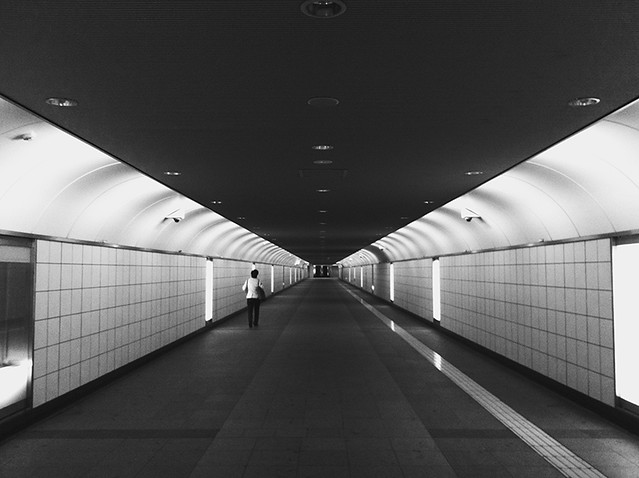
In Tokyo we’d walked long. I didn’t know where we were. It didn’t even matter. We were walking and it seemed to get less busy one corner though there were high rises cutting off the other high rises and apartments and shopping mazes at other corners--dubious apartments--two-hundred square-foot normal sized homes. Homes. The place that follows when you leave your first. Though hardly doubtful are the sky malls. Shopping for stories of clothes. You buy the clothes and you hope to take it through many stories that you call life, because if you don’t, what’s the point in wearing nice ones?
Sharpness and brightness everywhere. We cut in between the people. Lots of people and corners. Lots of lots of everything. Above there was sky somewhere. At night, you doubted there were stars but there were there as they’ve always been.
Everyone was going somewhere and Em and Ro and I were going to Sarugaku for coffee. It was first on our things to do because that’s how coffee works. Or you can be one of those that have coffee for dessert. That’s my kind of people too.
The roadway was high. A broad concrete line that curled into the distance. Stilts and pylons. A futuristic city imagined out by Astro Boy’s creator, Osamu Tezuka. You build upwards and catch all the sunrays. You align streets and concrete and steel in grids like London or New York, if you're Kyoto. But if you're Tokyo, you follow radial patterns like Paris until it touches the harbors, the seas.
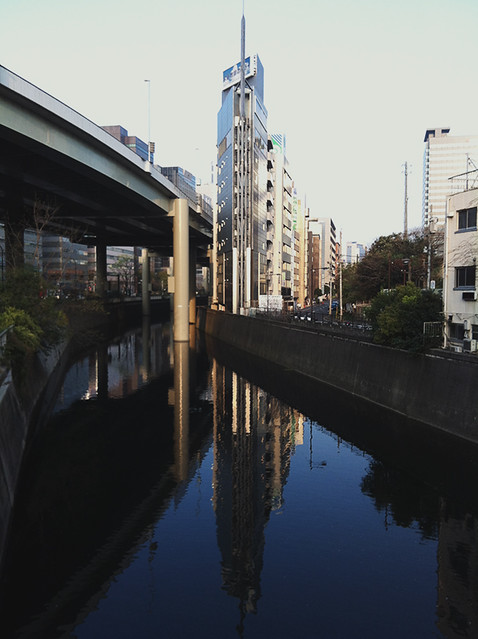
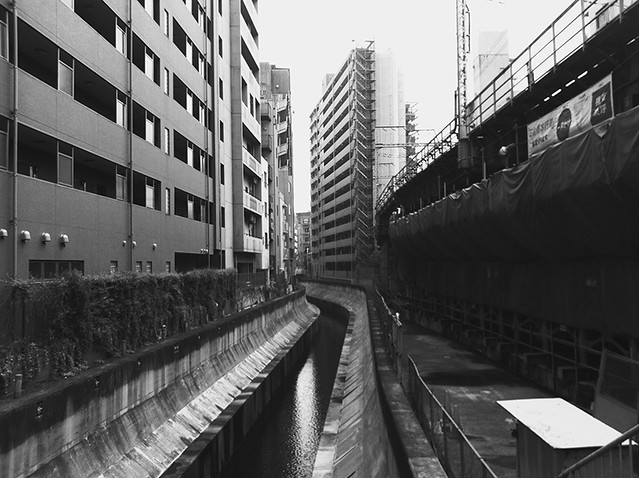
Ro rechecks her phone. We got here too early. It’s not open yet.
“Well,” I say. “Guess we’ll go busy about.” Yes, I talk like that.
The sidewalks are clean. It’s not so obvious to tell who the trashy patrons of some trashy establishment are by sorting through the litter in Japan. The concrete is white in the scaling early light. Up some wooden stairs, a sign claims to be a gallery so we check it out.
Through the windows the walls of the bright and open room are blank. Solitary hooks hanging. Nothing hanging on them. The windows drawing slanted lines on the wood slatted walls.
“Address?”
“Yeah. This is it.”
Someone’s inside. A middle-aged woman in a flawless gray skirt and off-white top with a simple necklace barely showing through the collar. And bangs.
“Hi, is this the gallery?”
“Hi, yes it is. We haven’t quite put it up yet. We apologize.”
“Oh.”
Leave the walls blank. Leave it and let it sit in the sun long enough to reach an aged patina. Where the light was drawn it will last longer than perhaps the art that will decorate it. Trinket stores, yet tasteful somehow. Do we really need a wooden dog with a recess in its head? What’s it supposed to do? It looks nice, honey. Boutiques of all kinds. APC in Tokyo. Walked through the hall of pebbles and trees. The store people watch us through the sightless glass. You don’t have to bow to everyone, shit, you’re not supposed to, but I do. Yoshida says I’m awesome at it. I touch the flecked black raw denim.
“Why does it say Made in China? Isn’t it supposed to be designed in Paris and made in Japan with Japanese cotton? The serious hell.” That’s also how I talk. “If you’re going to buy out the world’s supply of the best cotton, why the fuck? You buy out the world’s supply of Blue Mountain and hell, the even the best beans for Starbucks Japan, so what the? Seriously. Do you people--”
“Calm down.”
Parts of the world have since learned that the Made in China tag is sometimes fine. Some of your best mills are there because they’ve been producing textiles forever and have refined it on all levels. Of course, there’s refinement and then there are those that still cheat and skimp. You want to talk really cheap labor? Made in Vietnam. Made in USA is neither the surest badge of trust or of anything other than an obnoxious logo which you’re not even getting paid for wearing but you’re glad to wear it anyhow. Are you paying for American workers’ benefits? You are. Are their employers? You’d have to ask them. You’d have to ask if they’re anemic elsewhere than their tax filings.
Your Toyota truck was designed in Japan and made in the USA. My Honda is made in the USA. Parts from everywhere else though. The rubber tires probably from some sad part of a burnt-out rainforest. The Bay bridge. Made in China. Assembled in USA. Designed by a multiculturalist. Who cared about that old forgotten NYC garment district until some obsessed Japanese guy started making designed in NY, made in NYC clothes, you know, since like when only immigrants with sewing skills could get by on a dime long enough to make their sons and daughters lawyers, or since like when forever because living man’s skill and poor man’s food will always get appropriated as trendy for rich people. Speaking of designed--Apple--designed in Cupertino California and made in the grand Chai of Na. Take your stupid cover off, and it clearly says so. Designed. Designed. Designed? Foxconn workers probably get paid better than some “living-wage” Americans. Well, now if only they had weekends, we could argue about quality of a thing, or the quality of life. All that said, I cannot say I feel the same about Made in Japan and then in suddenly elsewhere China. Random internet tirade criticizing makers and shakers who have done a thing, done things. Easy not to be in the arena talking, or you’d get gored while yammering on a keyboard.
We go upstairs, try on a blazer.
“God. Don’t need a mirror.”
“Too big?”
Even in Japan sometimes.
The sun is vertical, taller than the buildings all. Before there were cities, before we lived in them, there was nothing taller than the sun. We stand on the ground floor looking down into the stairs where the sun is irrelevant. We foot down. Wooden archway, vines dangling from the other side. Go through the arch or through the glass door before it? So if you one day end up in this place, I already know the answer--my advice is to not so easily take that right turn. That’s the “other” café. That’s not what you want or you wouldn’t have read this far into this article this deep into the blog.
We go further on and open a door after archways and flora. Salarymen and their attaches and cases and three, four, eventually five of them head out of the door, their faces, their eyes, their hair as black as the missing sun you can still feel glaring in the bright concrete world above at the moment. We head inside and it’s dark and small and detailed. Old stuff but not the dust. The man in the darkened orange and darkened wooden room says hi. Friendly, enough, anyhow.
“They must not like dark and scary.”
“Well, heard this place is only for people who want coffee.”
“And what’s wrong with that? So what there’s no place for five people who want to sit together … and what … talk about business, or some equally dumb shit? That’s seriously dumb. Stop ruining coffee.”
The menu. “It takes time. Please pay when the coffee is served. Does not come with cream and sugar. For cold, plus 100 yen.” You get coffee. You get it black, or not. You get it with a choice of cheesecake or not, or coffee jello, or honey toast, or kinako chiffon. Your choice is to have this fine, fine coffee, slightly bitter, or not, or deeply roasted, with brown sugar, or not, or milk, hot or cold, or go next door, where there are actual choices. Is there ever such a thing as choice when the best exists and you can afford it? What is best in life? Crushing and lamentation are free. Coffee is not. The other choice is to cheat yourself out of life. You should always have the omakase. Train yourself in discernment only. Let the pros make the decisions for you.
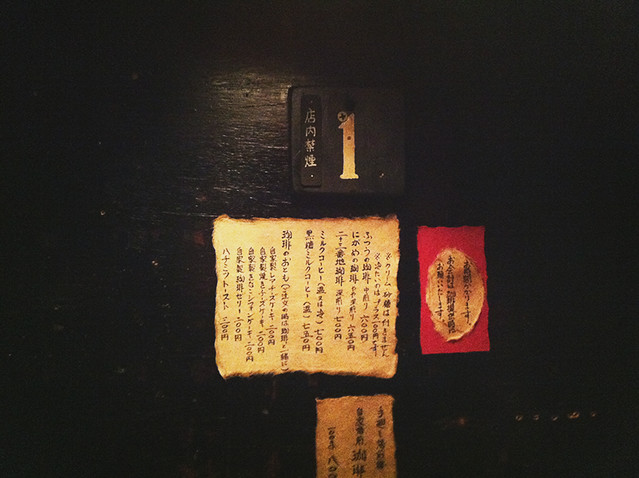
Our hushed voices, just the three. Em and her sister and me. I can’t hear the guy in the other room behind the counter. We call him Sarugaku. He might as well own the place, the whole shebang beyond this cellar café, so he should at least own the name. I might have heard the clink of metal against ceramic or the drip drip drip of single serve. I did not miss him grinding it, likely with a hand mill. We’re quiet because we’ve talked so much already. Then we realize that in fifteen minutes the coffee hasn’t come out yet.
“Really taking his time, as if the longer he takes the tastier the coffee will be. Which is true, of course.”
“The menu says that he takes his time, or it’s ready when it’s ready.”
“Why is there a menu?”
I finish the last sip. The clean wedgwood cup glows white in the basement room, not cold, not too warm, with a single bulb that had light in our black drink, our shrouded faces pressed forward so we can see the other’s eyes, so we can talk to it. I invert the cup, the saucer. 1984 Wedgwood. A fine year, for a very fine coffee.
Story by HVH
